
In Defense of Animals fights for animals, people, and the environment, and that includes you. We support full body autonomy and freedom of choice, and we support families — whatever that looks like for you.
As stewards of the Earth, we must acknowledge the impact our choices have on the rights of animals and the environment. With nearly every decision, we have an opportunity to create a positive, neutral, or negative change for all living beings.
“Human population growth’s… seriousness, and preventability, are not being addressed in any country or internationally. The key question is ‘How can we slow both population growth and its impact in ways that can enable survival and prosperity for all?’”
It is vitally important and practically possible to reduce humanity's impact on animals and the environment — but only if we tackle this delicate issue with kindness and an open mind. We share this information to encourage more mindful living so we may create a fairer and more balanced world for all beings.
Definitions, Causes & Effects
Has Our Human Population Grown Significantly?
Why Is Human Population Overshoot A Problem?
What Does Human Population Growth Have To Do With Animals?
Who & What Is Affected By Too Many Humans?
What Do People Think About Human Population Growth?
Common Questions
Human Population Growth Is Slowing — Will That Fix Things?
What If We Slow Down Or Reverse Human Population Growth?
Can We Keep Adding Kids If We Live A Lower-Impact Lifestyle?
Can’t We Fix Human Impacts By Going Vegan?
Doesn’t The World Need Humans To Exist?
It’s Natural to Have Children, So Why Not Have A Baby?
Won’t The Next Generation Discover Technology To Save Us, Animals & The Planet?
What If We Just Replace Ourselves?
Are You Suggesting We Kill Ourselves To Balance the Human Population?
Aren’t Capitalism, Corporations, & The Economic Systems To Blame?
People in Other Countries Have More Children – Aren’t They the Problem?
Isn’t “Overpopulation” An Excuse To Blame & Oppress Low-Income Countries?
What You Can Do
How Do We Achieve a Sustainable Human Population?
What Can You Do To Save Animals & The Environment From Human Population Imbalance?
Other Ways To Reduce Your Impact On Animals & The Environment

Definitions, Causes & Effects
__________________________________________
What Is “Human Overpopulation?”
Overpopulation is a condition in which a population of any animal grows to a size at which it begins to destroy its environment.
Carrying capacity is a term used to describe how much resource extraction a certain area can sustain. Overpopulation is the condition at which there are more individuals than the area can support, and so the individuals begin to dangerously deplete that area’s ability to support an abundance of life moving forwards.
Overpopulation is caused by some combination of two factors: a decline in the death rate, and/or an increase in the fertility rate. If more individuals are being born than are dying, the population size will increase. If this pattern continues until the total population size becomes a threat to itself, its fellow animal species, and the broader environment, this is overpopulation.
When referring to human overpopulation, we tend to use the terms “human population overshoot” to refer to the problem, and “population balance” for what we’d like to achieve.

Human population overshoot means taking more resources than Earth can sustainably provide — more humans means fewer wild animals, and a lot more farmed animals. Data: 1900,2000: Vaclac Smil; 10,000 BCE, 1950, 2050: Paul Chefurka
Has Our Human Population Grown Significantly?
For most of human history, there were relatively few humans. Around year zero, there were approximately 300 million humans, and one thousand years later, there were only 310 million. This is a 3% increase over a period of one thousand years.
Since then, and in particular, since the industrial revolution of the 18th and 19th centuries, the rate of population growth has vastly sped up. Eight hundred years later, by the year 1800, there were approximately 1 billion humans. By 1930, 130 years after that we added the next billion. Thirty-two years after that we added the next billion.
| Population | Year |
|---|---|
| 0.05 billion humans | -1000 |
| 0.17 billion humans | -0 |
| 0.25 billion humans | 925 |
| 0.5 billion humans | 1650 |
| 1 billion humans | 1800 |
| 2 billion humans | 1930 |
| 3 billion humans | 1963 |
| 5 billion humans | 1987 |
| 6 billion humans | 1999 |
| 7 billion humans | 2011 |
| 8 billion humans | 2023 |
| 10 billion humans | 2050 |
| 9-12 billion humans | 2100 |
Today there are approximately 8 billion humans alive. We are currently adding around an extra billion people every 12 or 13 years!
The United Nations estimates that the total human population could rise to over 12 billion by 2100.
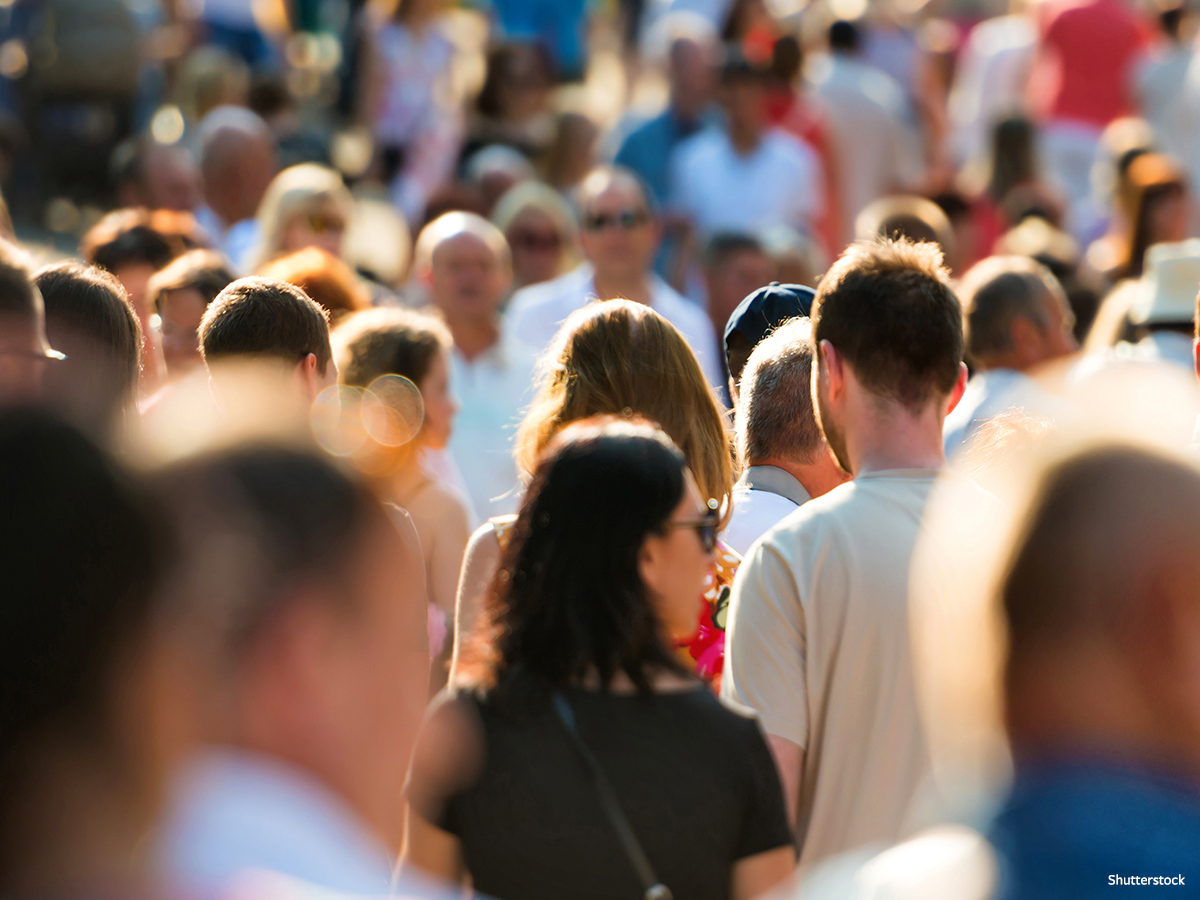
Photo: Shutterstock
Why Is Human Population Overshoot A Problem?
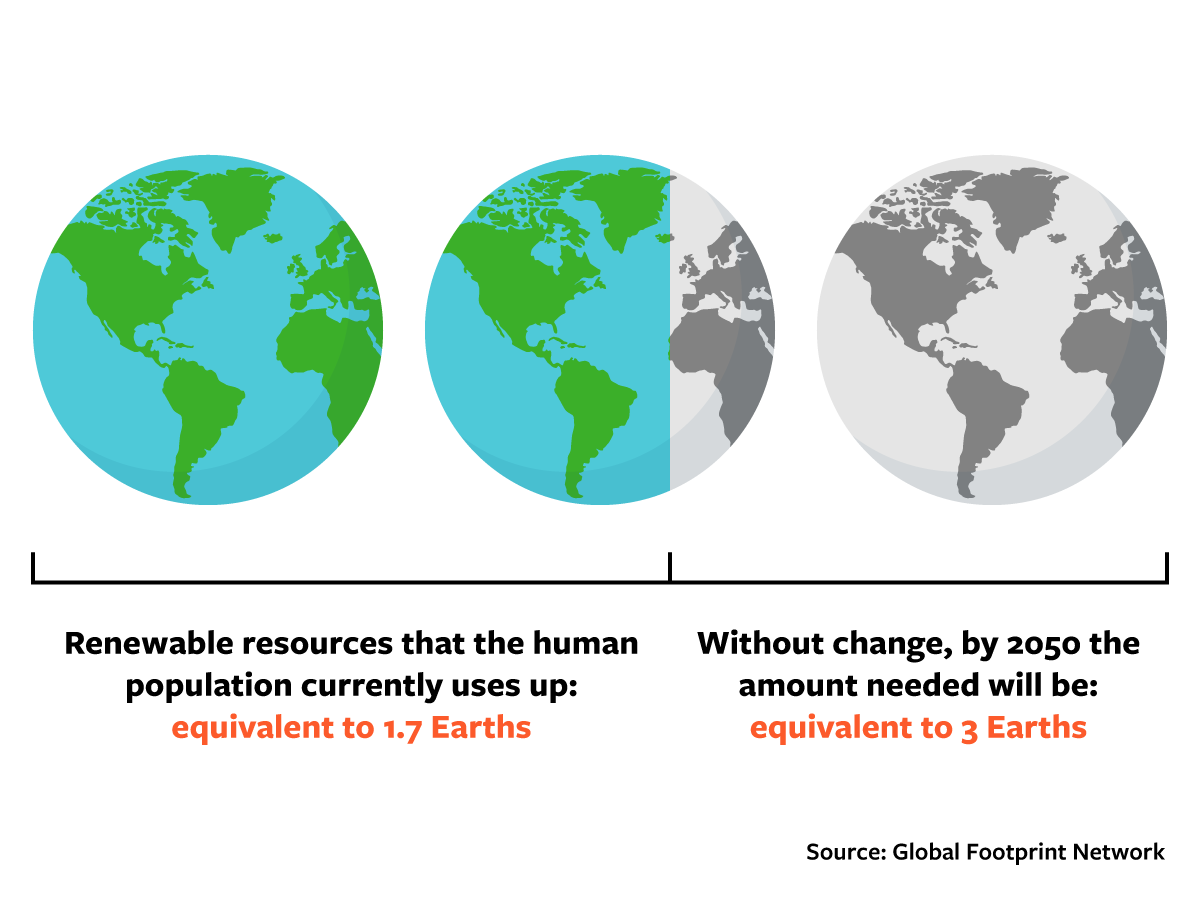
A crucial concept here is “ecological overshoot.” Overshoot is the idea that we use more resources than the Earth can regenerate. Today we are using up the renewable resources equivalent to 1.7 Earths… and by 2050, we’ll need three Earths.
Source: Global Footprint Network
For most of human history, our species lived how other animals do — taking what we needed to survive and not much more. Earth was abundant with resources for all species. With the rise of industrialization, humans started to exploit animals, including other people, and the Earth for profit and power. Conquests, colonialism, and industrialization have upset our planet’s delicate balance.
With 8 billion humans alive today, and with the full power of modern technology at our service, we are burning through Earth’s finite resources at an extraordinary speed. We see it in mass extinctions and extreme weather events. The more humans we add to the planet, the more pressure we potentially put on Earth’s resources.
What Does Human Population Growth Have To Do With Animals?
Human population imbalance affects us all, and animals suffer immensely. Every extra person we add to our population will, on average:
- eat hundreds of animals each year
- displace and therefore cause the death of local wild animals through habitat loss
- drive animal species toward extinction by contributing to the climate crisis
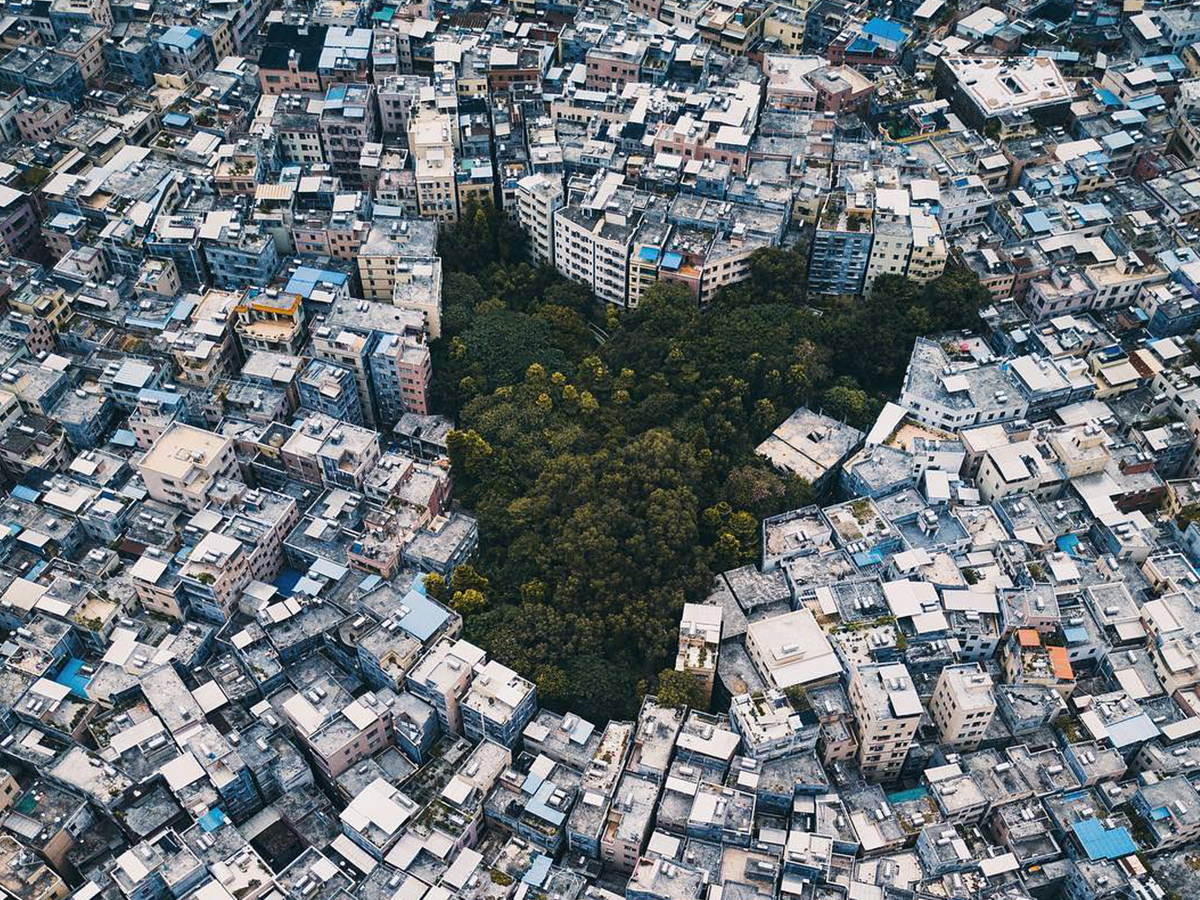
Photo: Imgur
Who & What Is Affected By Too Many Humans?
We are all affected by human population growth, because we all need resources and space to thrive and survive. The Anthropecene era in which we have become so abundant is marked by a loss of biodiversity, the climate crisis, and harm to ecosystems.
Animal Harms
“Animal agriculture is one of the most destructive industries on Earth and a leading cause of biodiversity loss, demanding immense amounts of land, water, pesticides and fossil fuels.”
— Center for Biological Diversity
The vast majority of new humans added to the planet will eat and use animal products. Thus the demand for animal products will continue to increase as the population does. Billions of more land and sea animals will be bred, confined, abused, and killed, to meet the growing demand of the human population. The suffering of animals will increase exponentially in line with the human population.
You can learn more about the harm we cause to animals by eating them here.
Climate Crisis
The climate crisis causes extreme weather events, heat waves, droughts, megafloods and sea-level rise. We are melting the arctic ice, and turning once fertile lands into deserts. Whole regions of Earth are gradually becoming uninhabitable by humans and animals, and animals who cannot migrate quickly enough will be lost. An estimated 13 million humans living in the U.S. will be forced to move away from submerged coastlines due to sea level rise. The more humans we add to the planet, the more pressure we put on Earth’s climate.
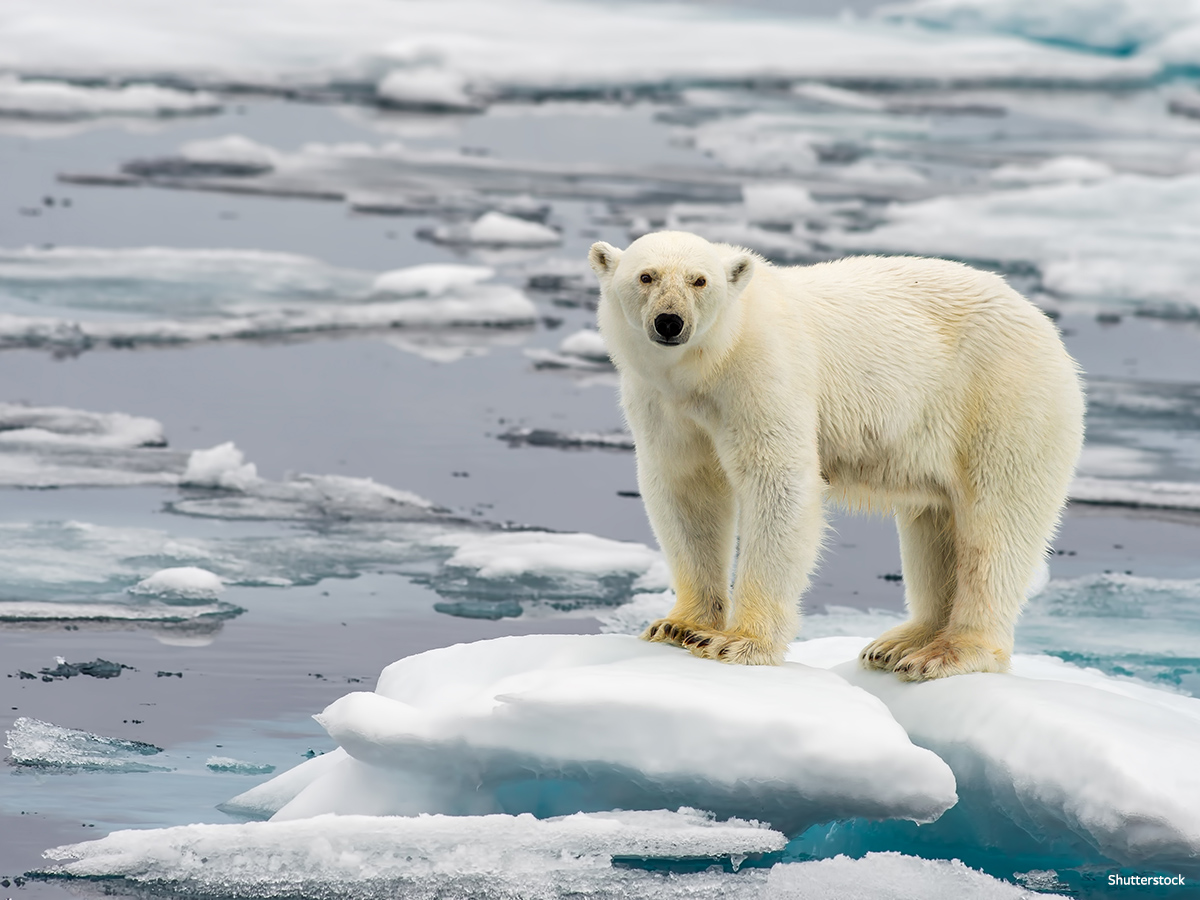
Photo: Shutterstock
Energy Instability
We are rapidly burning through the carbon energy reserves on Earth (oil, coal, natural gas, etc.). Used in moderation, these are invaluable gifts from our planet. But we are burning through them as quickly as we can, regardless of the pollution they cause. The more humans we add to the planet, the more pressure we put on Earth’s energy resources.
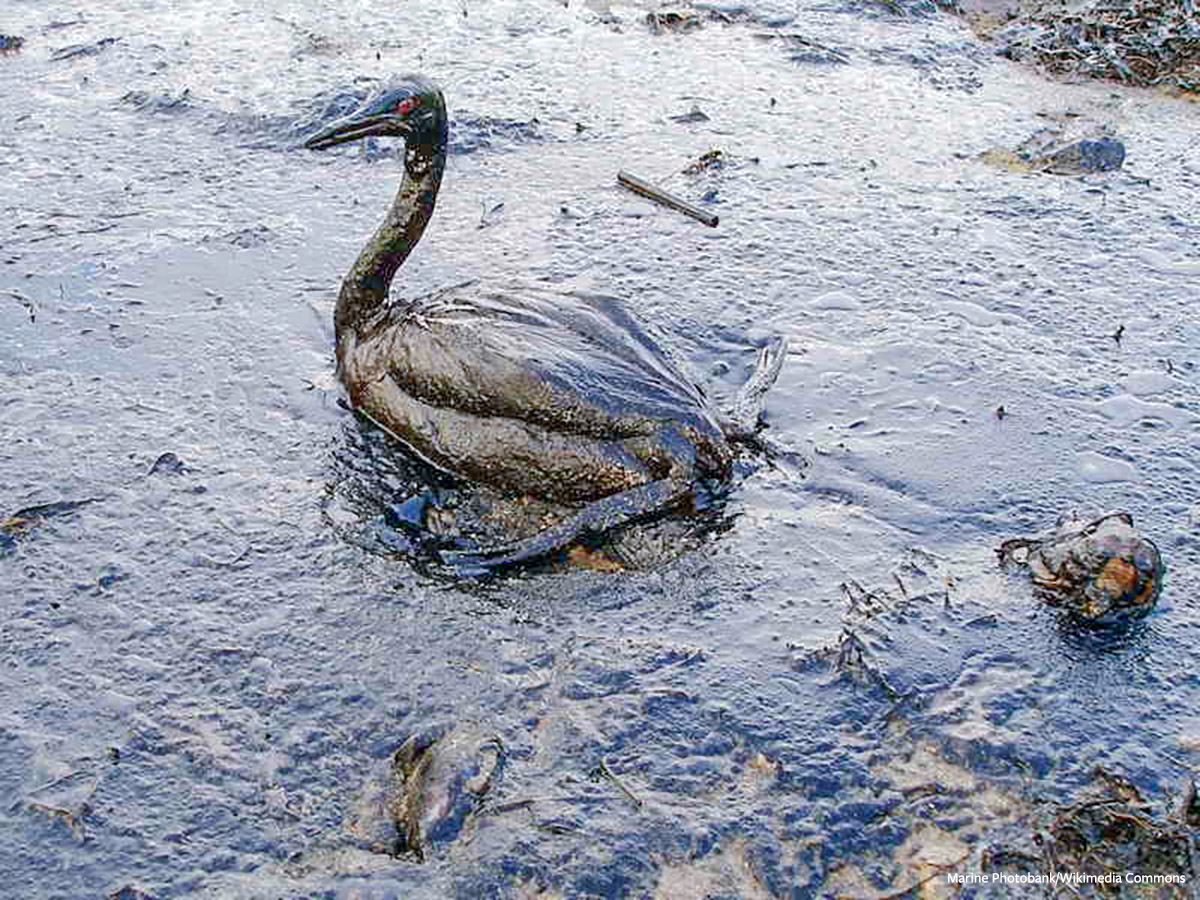
Photo: Marine Photobank/Wikimedia Commons
Water Scarcity
Clean, drinkable water is becoming scarce for two reasons. Humans are polluting it with plastics, and waste products from our technologies and the animals we farm. And it is disappearing entirely, either being diverted for human purposes, including watering our lawns and farmed animals again, or evaporating entirely due to the rising temperatures associated with the climate crisis. The more humans we add to the planet, the more pressure we put on Earth’s water resources.
Habitat Loss
Our needs are often put before respect for the wilderness. We dam rivers, and we clear forests, turning them into cropland for farming or pasture for animal grazing. Even where expanses of semi-wilderness remain, we subdivide them with roads that hinder the free movement of animals. The population is increasing by a net growth of 80 million people per year — which is the size of the population of Germany! We have created a land-grab disaster.
As the human population grows, so do our housing needs and cities. We tear down natural areas and the homes of animals to build and expand our own homes and cities. As infrastructure increases in the U.S., a football field worth of nature is destroyed every 30 seconds! Human expansion displaces animals. The more humans we add to the planet, the more pressure we put on Earth’s wilderness.
Our own human habitats are under immense pressure, and our impacts on the planet are already forcing humans to migrate away from destroyed areas.
Biodiversity Loss
"Many scientists believe we are living through the sixth mass extinction – the largest loss of life on Earth since the time of the dinosaurs – and that it is being driven by humans."
— Patrick Greenfield and Max Benato, The Guardian
We are currently living through the sixth great mass extinction event in the history of our planet. Humans are currently causing a comparable amount of harm to the massive asteroid that killed the dinosaurs millions of years ago. And of course, the harm humans cause also impacts animals, and leads to the loss of biodiversity.
At least 10,000 species go extinct every year. Experts estimate this rapid loss is between 1,000 and 10,000 times higher than the natural extinction rate. Another way to put it, it’s estimated that an entire species goes extinct every 20 minutes. Unfortunately, the more humans we add to the planet, the more biodiversity we lose forever.
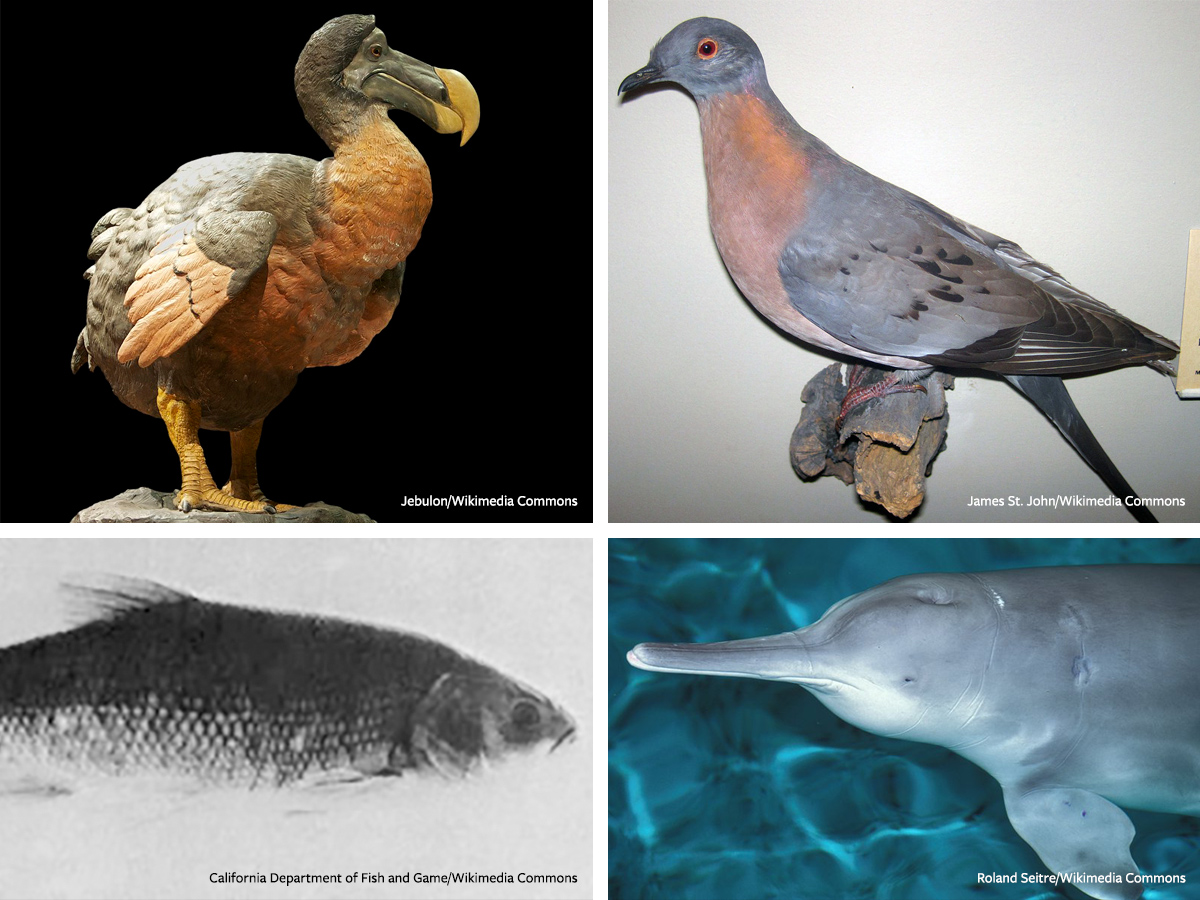
The Dodo, Passenger Pigeon, Thicktail Chub , and Baiji Dolphin were all killed off by human-caused habitat loss and hunting. We are losing many other species to extinction for the same reasons: human expansion and exploitation. Photos: Jebulon/Wikimedia Commons, James St. John/Wikimedia Commons, California Department of Fish and Game/Wikimedia Commons, Roland Seitre/Wikimedia Commons
Pandemics
Diseases spread when individuals are kept in close quarters, and the conditions are unsanitary. This is certainly the situation for the animals humans exploit for their flesh, secretions, and furs. Animal farms and wet markets are breeding grounds for new and deadly infections. Some examples of zoonotic diseases are Bird-Flu, Swine-Flu, Lyme disease, Anthrax, Plague, Salmonellosis, and Covid-19. In fact, 3 out of every 4 new or emerging infectious diseases in people come from animals. As long as billions of humans depend on the products of animals held captive, deadly pandemics will threaten us and other species. And the next outbreak may be far more deadly than any we have seen before. The more humans we add to the planet, the more likely diseases and pandemics will develop.
What Do People Think About Human Population Growth?
Celebrities
"What will the world be like when there's no more wilderness, or wild animals, or marine life because one species of animals — homo sapiens — has taken up all the space and resources?"
— Jane Fonda
— Aldous Huxley, Author
“The planet can't sustain seven billion, let alone 10 billion. It's such a complex problem. And nobody's dealing with it. Nobody!”
— William Shatner, Actor
Environmental Stewards
“Although people will say, ‘In the long run, we are going to stabilize,’ they’re going to stabilize — as far as I can see — at a rather higher level than the Earth can really accommodate.”
— Sir David Attenborough, Naturalist & Broadcaster
"Finally, we cannot hide away from human population growth, because, you know, it underlies so many of the other problems. All these things we talk about wouldn’t be a problem if there was the size of population that there was 500 years ago."
"I would encourage every single conservation organization, every single government organization to consider the absurdity of unlimited economic development on a planet of finite natural resources… Already in some areas, we are using up these precious natural resources faster than Mother Nature can restore them. We can’t go on like this. We can’t push human population growth under the carpet. We must find ways to address it."
— Dame Jane Goodall D.B.E. Ph.D, Primatologist & U.N. Messenger of Peace
— Jo-Anne McArthur, Photojournalist & Humane Educator
“For me it’s been the most important thing to think about for a long time. It is undeniably, the elephant in the room... More people, more consumption, more climate change; more people, more consumption, less wildlife.”
— Chris Packham, Natural Historian & Broadcaster
“For as long as I’ve been campaigning on environmental issues, I’ve been utterly perplexed that recognition of the role of human overpopulation in the extinction crisis is widespread among conservationists and conservation scientists but has been almost invisible in public and policy debates… Over the past fifty years, the human population has doubled and wild animal populations have halved. Undoubtedly, if we’d taken steps to prevent that population explosion then, biodiversity would be in a less perilous state today.”
— Jonathon Porritt CBE, Environmentalist
"If there were fewer of us, we would have less impact. We must consume less, and more importantly, we must breed fewer consuming humans."
— Tracy Stone-Manning, Director of the Bureau of Land Management
"To have driven to extinction a species that roamed the Earth for millions of years before us speaks clearly about the dangerous manner in which humans as a species are aggressively crowding out everything else out of existence."
— Kamalpreet Singh Gill, Writer
Organizations Raising Awareness of the Impact on Animals of Human Population Imbalance
- Animal Legal Defense Fund
- Center for Biological Diversity
- Fair Start Movement
- Having Kids
- In Defense of Animals
- Institute for Humane Education
- Lady Freethinker
- PETA
- Population Balance
- Population Matters
- Stop Having Kids
- The Royal Society
“Restoring the balance of nature is at the heart of everything that we do, and every decision we make can help in the fight to save our world.”
— World Wildlife Fund-UK
Common Questions
Human Population Growth Is Slowing — Will That Fix Things?
It is true that the rate of population increase is gradually slowing, though the United Nations estimates that the human population will reach at least 11 billion before the growth stops entirely.
Are we supposed to take comfort in the fact that the total human population will increase again by almost half from here? Projections that the growth will stop at some point in the future should not be comforting; they should be terrifying. We need the total population to decrease from here, not continue to increase.
The dire problems our planet and all species face are exacerbated by adding 1 extra human or 10. There is no magic number that makes adding to the population justifiable at this point — the ethical question of adding to the population is the same.
There are currently approximately 8 billion humans on Earth. It is the demands of these 8 billion people that are causing the current mass extinction event — which is almost unprecedented in the history of our planet — as well as driving the climate crisis and the extreme weather events that are destroying cities and causing humans and animals to migrate away from or perish in increasingly uninhabitable regions.
“Although people will say, ‘In the long run, we are going to stabilize’, they’re going to stabilize — as far as I can see — at a rather higher level than the Earth can really accommodate.”
— David Attenborough, famed naturalist and TV presenter
What If We Slow Down Or Reverse Human Population Growth?
The challenge to animals, the environment, and all life as we know it comes from a combination of two things: total human population size and our resource consumption.
And it is here that high-income nations must consider whether they are to blame. As our societies get richer, we consume more: carbon-based fuels, animal products, plastic-wrapped consumer goods, bigger houses, more vehicles, more air travel, more of everything.

Rich countries consume more of everything, from animal products to carbon. Source: Oxfam
If the total human population decreased by 50 percent, but the average consumption doubled, we would not have made any progress toward saving animals and the planet.
As our nations get richer, our thirst for resources increases. Therefore, the solution lies in both reversing population growth and reducing our consumption.
Can We Keep Adding Kids If We Live A Lower-Impact Lifestyle?
Can those living in developed nations minimize their impact to levels as low as people living in developing nations? Let’s take carbon emissions as one way to measure our impact on the Earth and animals. An average U.S. citizen could minimize their footprint by moving to the most high-density urbanized state, New York. Doing so would reduce their carbon emissions significantly, but they would still emit more than four times as much as someone living in India. They would still be using more carbon than is sustainable if everyone on Earth were to live as a New Yorker.
Another way to reduce your impact significantly enough to come close to a person living in India would be to adopt a lifestyle consistent with how U.S. citizens lived in the 1800s — which means no cars or planes, and likely eating only what your local community grows.
Theoretically, we could collectively choose to significantly reduce our living standards, or look to house everyone in hyper-dense cities to accommodate population growth… but a simpler and more comfortable option is to choose to have smaller families.
Discover what you can do to reduce your impact on animals.
Can’t We Fix Human Impacts By Going Vegan?
It is absolutely paramount for animals and the planet that people live a vegan lifestyle, and that any children added to the planet are at least raised vegan.
However, a vegan world alone is unfortunately not the sole answer to the issues caused by the growing human population.
Let’s look at one measurable example of human impact on animals and the planet — the climate crisis.
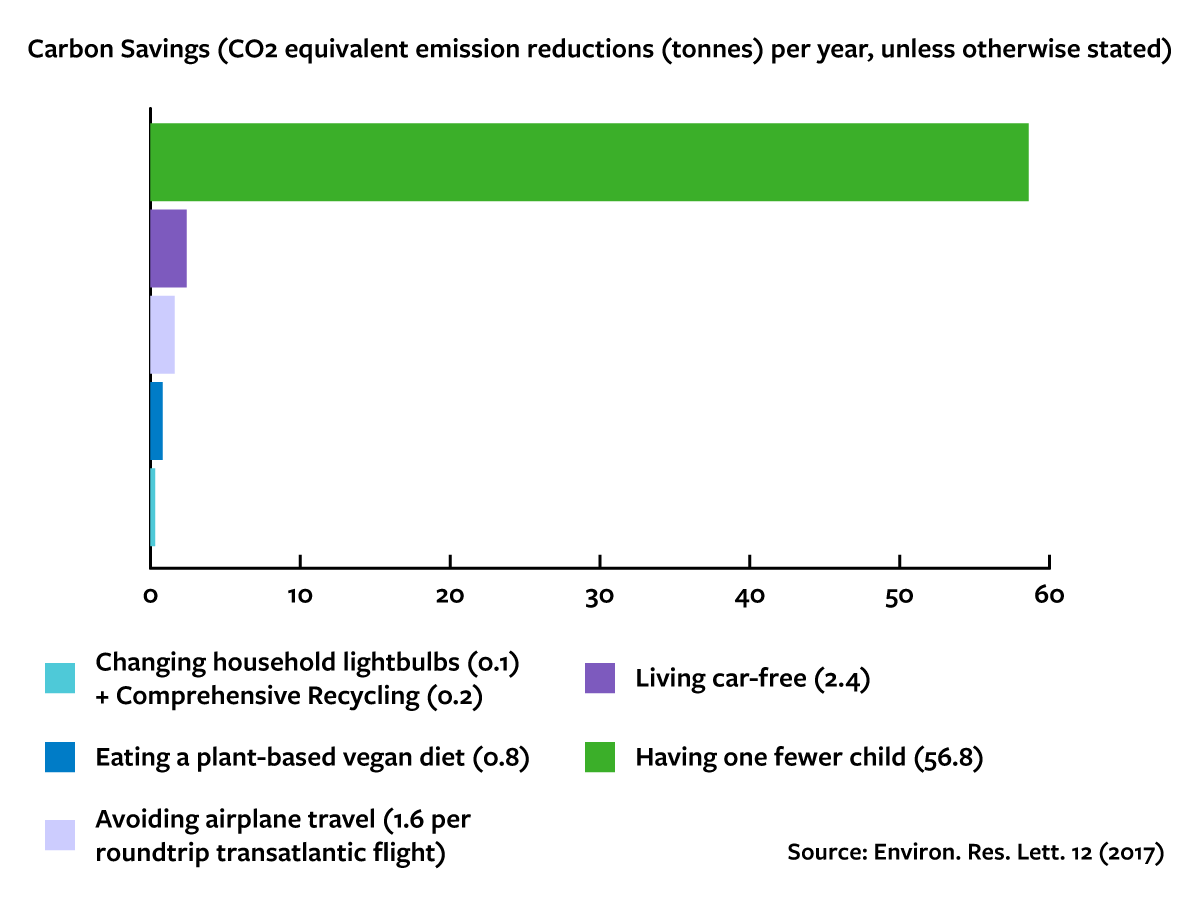
A 2017 study revealed the single most effective action to mitigate climate change for people living in developed countries is to have one fewer child. Having one less child is more effective than following a plant-based diet, plus all other emission-reduction actions combined!
Source: Environ. Res. Lett. 12 (2017)
Carbon Savings
(CO2-equivalent emission reductions per year, unless otherwise specified):
- Having one fewer child: 58.6 tonnes
- Living car-free: 2.4 tonnes
- Avoiding airplane travel: 1.6 tonnes per roundtrip transatlantic flight
- Eating a plant-based vegan diet: 0.8 tonnes
- Comprehensive recycling: 0.2 tonnes
- Changing household lightbulbs: 0.1 tonnes
Having one less child saves the same amount of carbon as 36 transatlantic flights, or 24 people choosing to live car-free.
Lowering your impact — such as by recycling or living a vegan, car-free, or plane-free lifestyle — can make a difference. But everyone, especially those of us living in the U.S., still has a harmful effect on animals and the environment.
Because vegans don’t support the exploitation of farmed animals, they generally require less land and water, and produce less pollution, compared to non-vegans.
All humans (including those who live vegan and make other lower-impact lifestyles or not) require land for agriculture, housing, fuel/energy, clean water, finite mined resources — the list goes on. Other animals always suffer as a result of what we do and what we consume. When we live in high-consuming countries, we drain even more resources as our consumption of goods and infrastructure expands.
Our ever-growing demand contributes to the expanding human footprint, which encroaches on animals’ homes, causes displacement and death (as displaced animals usually die as a result of their displacement), and adds to the problem of our unsustainable existence on this planet.
There’s also no guarantee that children raised in lower-impact lifestyles will continue to live that way for the rest of their lives, or raise any children they may have in that way. So although Earth-conscious parents may have the best of intentions, we all know from personal experience that we don’t live our lives according to what our parents desire for us.
We also need to be realistic and look at this situation objectively. Numbers fluctuate, but roughly 1% of the population is vegan, so let’s work with that.
Every day, 230,000 new humans are added to the population after deaths are subtracted — it’s a staggering number. We are already seeing massive problems affecting animals and the environment with the people who currently exist. If only 1% of the population is vegan now, then that means 227,700 animal-eating humans are added to the population every single day. That’s terrifying for their animal victims.
Basically, it’s a numbers game. Despite all our best efforts to bring about change for animals and the planet, our rapidly increasing numbers are working against us, displacing 230,000 humans’ worth of other animals, each and every day. Once again, people making an effort to live lower-impact lifestyles having children today are still contributing to the current unsustainable imbalance on Earth despite their children (and future generations) living lower-impact lifestyles for their entire lives.
It is absolutely essential that we voluntarily rebalance to a sustainable human population size and do all we can to reduce our impact.
Doesn’t The World Need Humans To Exist?
Human population growth has been named one of the top 10 threats to humanity. Though it may seem counter-intuitive, adding more humans doesn’t lower the risk of human extinction… it increases it! This is because adding to the human population “exacerbates all other threats,” including:
- Decline of key natural resources and an emerging global resource crisis, especially in water
- Collapse of ecosystems that support life, and the mass extinction of species
- Global warming, sea level rise and changes in the Earth’s climate affecting all human activity
- Universal pollution of the Earth system and all life by chemicals
- Rising food insecurity and failing nutritional quality
- Nuclear arms and other weapons of mass destruction
- Pandemics of new and untreatable disease
- Advent of powerful, uncontrolled new technologies
- National and global failure to understand and act preventively on these risks.
"As well as keeping the planet more habitable for us and other species, “ethical measures for fertility reduction now… could avoid millions of [human] deaths by midcentury.”
— Proceedings of the National Academy of Sciences
It’s highly unrealistic to think the end of our species would be caused by people choosing not to procreate, but if this were to happen, the world would not end; it would continue. We are just one of the billions of species who have inhabited the Earth. Considering all the problems and destruction we have caused, the planet may actually thrive without us, despite all the pollution and problems we leave behind.
Think about the fact that despite over 30 years of vegan advocacy, only one percent of the human population is vegan at any one time. And despite the increasing market for plant-based meat alternatives, the amount of meat consumed per capita is actually increasing.
Not adding new humans to the planet is the most impactful way to prevent harmful human impacts on ourselves, animals, and the environment. However, many will continue, so there is little danger of all humans refusing to procreate and causing the extinction of our species.
It’s Natural to Have Children, So Why Not Have A Baby?
What is natural isn’t always practical, or in this case, possible to continue without dire consequences. We have created an unsustainable situation that negatively affects our own species and all other living beings on Earth.
If you want to raise children, there are many options to consider:
- playing a bigger role for young people already in your life
- mentoring in youth programs
- teaching
- volunteering with kids
- hosting students studying abroad
- adoption and foster care
Adoptive families tend to be better educated and more affluent. Many have chosen adoption to build a family, with around 5 million U.S. citizens alive today who are adoptees. There are roughly 450,000 children in foster care in the U.S. today waiting to be adopted by a loving parent.
In Defense of Animals also emphasizes the importance of cats, dogs, rabbits, birds, and other domestic animals as part of the family. Animal companions help us fulfill our natural instincts to nurture and care for others while building a loving and supportive emotional environment. Having an animal family is incredibly rewarding, so why not consider adding to your family by adopting an animal?
Won’t The Next Generation Discover Technology To Save Us, Animals & The Planet?
There is no sign that a technological advance is on the horizon that will save us from ourselves. All the information we have available shows us that increasing our population size will continue to increase harm to animals, the environment, and each other. The lives and wellbeing of everyone on Earth are far too precious to gamble on a technological advance that may never come.
"Despite the science, the catastrophic projections, the impassioned speeches and promises, the burning forests, submerged countries, record temperatures and displaced millions, world leaders continue to sit back and watch our world burn in front of our eyes… The climate and nature crises, their fates entwined, are not some faraway threat our grandchildren will solve with still-to-be-discovered technology.'”
— Tanya Steele, CEO at the World Wildlife Fund-UK to The Guardian
What If We Just Replace Ourselves?
Unlike some animals, humans don’t reproduce and then die. On the contrary, we multiply exponentially. Four generations of one family can often live all at the same time. Their impact on the planet and animals is made simultaneously and can continue for quite some time before the older generation passes on. Also, when we already have at least 4 times more humans on the planet than we can sustain, “replacing” ourselves is unnecessary and counterproductive.
Also, the impact of having even just 1 child doesn’t end there. That 1 child could potentially go on to have children of their own, and so on. A lineage of many generations could result from just 1 child - our impact on this planet and all other species goes far beyond our own lifetimes - it’s exponential.
Are You Suggesting We Kill Ourselves To Balance the Human Population?
Definitely not. 8 billion humans already exist, and their rights should be respected and protected. At the same time, we can choose to prevent more humans from being added to the population and making an already dire problem worse.
Aren’t Capitalism, Corporations, & The Economic Systems To Blame?
Economic systems undoubtedly oppress animals — the history of animal agriculture and capitalism dates back 10,000 years, as explained in The World Peace Diet:
For the old herding cultures, confined animals were not just food; they were also wealth, security, and power. The first money and form of capital were sheep, goats, and cattle, for only they were consumable property with tangible worth. The first money and form of capital were sheep, goats, and cattle, for only they were consumable property with tangible worth.
In fact, our word “capital” derives from capita, Latin for “head,” as in head of cattle and sheep. The first capi- talists were the herders who fought each other for land and capital and created the first kingdoms, complete with slavery, regular warfare, and power concentrated in the hands of a wealthy cattle-owning elite. Our word pecuniary comes from the Latin word pecus, meaning cattle, and the ancient Roman coin, the denarius, was so named because it was worth ten asses. Livestock in the ancient herding cultures thus defined the value of gold and silver — food animals were the fundamental standard of wealth and power. This fact gives us insight into the political might of the ranching and dairy industries that continues to this day.
— Will Tuttle, Author of The World Peace Diet
Economic systems like capitalism exploit both humans and other animals. Corporate-driven policies rely on the infinite growth of both profits and population. The system requires workers and consumers, and so it encourages human population growth to ensure its survival. This numbers game where “more is better” for the profit-making system is basically a population Ponzi scheme, and it’s bad news for humans, other animals, and the planet!
Having said this, it’s important to remember that destructive economic systems like capitalism are human constructs. We’re the ones who created this system, and we also continue to keep it afloat (even if we disagree with the system). So if humans are behind the very thing that is destroying us, then how can adding more humans to this system somehow be the answer? It’s not. As difficult as this may be to acknowledge — humans are not always the answer; in fact, we’re often the problem.
Considering the early roots of animal agriculture and capitalism, one could safely say that we’ve only seen staggering growth of this human-driven destructive system over the last 10,000 years. Expecting a miracle-next-generation-savior to fix everything is simply not realistic and certainly not something we can sit back and just hope for.
Whilst striving for a system change, we must also be practical and take responsibility in the present moment. By not adding more humans to the planet, we are also not adding more workers and consumers to the system’s insatiable engine. And in this way, we are actually helping to break the system down — it’s a win for animals, the planet, and humans.
People in Other Countries Have More Children – Aren’t They the Problem?
If a family living in a developing nation has several children, then surely that’s worse than a relatively wealthy couple having one or two children in a developed nation — right? Actually, that’s not the case.
The human footprint of western nations dwarfs that of developing nations. International think tank Global Footprint Network calculates we would need 5.1 Earths if everyone lived like people in the U.S.
Conversely, we would only need 0.8 Earths if everyone lived like people in India — which is often used as an example of a country that “has too many people.”
The answer is not to allow population growth only in low-income countries where we may be forced to have a lower impact, nor to prevent births in richer countries where we are forced to lead a higher-impact lifestyle. We must all be afforded the choice to live within our means on a global scale — this includes sharing our space with animals and the environment.
What does that mean if you’re now living in a wealthy nation like the U.S.? Despite having a lower overall birth rate than low-income nations, your footprint is most likely to be much higher than is globally sustainable. This is why you can have a massive positive impact by making family planning decisions that consider animals and our planet.

Source: National Footprint and Biocapacity Accounts 2022
Isn’t “Overpopulation” An Excuse To Blame & Oppress Low-Income Countries?
Scientifically valid concerns for animals and the environment posed by the rapidly increasing human population have nothing to do with oppressing people or eugenics, which aims to create the perfect human beings by selective reproduction.
The problems posed by human population growth disproportionately harm those in low-income countries and the Global South. People living in these countries are the least responsible for causing harm to animals and the environment, but are the most vulnerable to the effects of human population imbalance, such as pollution and climate change.
We support human rights for everyone and encourage equal access to education and healthcare so all people everywhere on Earth can make family planning decisions that consider animals and the environment.
Empowering women and men in low-income nations to make their own family planning decisions has a range of positive knock-on effects. Giving everyone a choice to delay or forgo parenthood presents greater opportunities to build financial stability, continue education, and contribute to our communities and society.
What You Can Do
__________________________________________
How Do We Achieve a Sustainable Human Population?
There is no silver bullet. The solution lies in a combination of factors:
Recognizing Childfree Lifestyles
Instead of adding to the human population, remember that it’s ok not to have children. This expectation is often forced onto us, and many don’t even stop to consider that not having children is also a valid option. If you do want to raise children, consider adoption or fostering a child. If you don’t want (more) children in the future, consider safe and easy permanent contraception like a vasectomy to prevent unplanned pregnancies — which account for half of all pregnancies in the U.S.! The most common form of contraception in the U.S. is tubal ligation which around 700,000 women opt for each year, and it works for the rest of your life. Learn more about birth control options here.
"I don't have this checklist of things that have to be done and if they're not checked then I've failed some part of my feminism, or my being a woman, or my worth or my value as a woman. I've birthed a lot of things, and I feel like I've mothered many things. And I don't think it's fair to put that pressure on people."
— Jennifer Anniston, Actor
"I love children. The only problem with children is they grow up to be people, and I just like animals better than people. It's that simple."
— Betty White, Actor
Technological Advancement
The most common proposed solution is but one of many. Green technologies and other technological advancements will help alleviate some of the harm we are causing the planet. But any gains from technological advancement are likely to be offset by increases in the global standard of living, and continued population growth. In addition, future technological advances are, by definition, speculative. They haven’t happened yet, and we should not hinge all our hopes on uncertainty.
Social Advancement
The importance of this cannot be overstated. Universal education is one of the two biggest factors in terms of declining fertility. When women and girls are empowered and have opportunities outside the home, the average family size is below replacement level. That is a fact. So in pursuing a goal that is desirable in its own right — the empowerment of women and girls — we are also making huge strides in reducing our exploitation of Earth and animals.
"It’s been shown all around the world as women’s education improves, family size drops, and it was the growing human population that was the worst problem destroying the forests in this area.”
— Dame Jane Goodall D.B.E. Ph.D
Universal Access to Contraception
Along with social advancement, this is perhaps the single biggest factor in terms of declining fertility. When people, especially women, are informed about family planning and given universal access to birth control, fertility rates decline.
Increasing Respect for Animals and Nature
Honestly put, we have got to get over our shortsighted focus on humans as the only important species on this planet. Earth is an interconnected web of diverse but related life forms. If you go back far enough in evolutionary history, all life on Earth is related. We should respect nature because it deserves respect in its own right. But we should also respect nature because our lives depend on it. Ecosystems are made up of diverse species who all depend on one another. When we ravage ecosystems with overconsumption, eliminating keystone species, we risk the collapse of those ecosystems. This is terrible for animals, but will undoubtedly come back to haunt us humans as well.
Funding for Developing Nations
Decreasing the human population and our resource consumption will require sacrifice from everyone. But the majority of the financial burden must fall on developed nations like the U.S. Our high quality of life was built, quite literally, on the exploitation of the Earth we share with all humans, and all other species. It is time for us to repay the debt that we are in by helping developing nations bring comprehensive sex education and contraception to all their citizens. Funding international development projects aimed at sexual healthcare and gender equality will result in an improved quality of life, and also a decrease in global population size.
Open Discussion About Human Population
We are beyond the point where it is acceptable for news publications and government entities to address the challenges our planet faces without addressing the mutually reinforcing problems of human population overshoot, human overconsumption, and animal agriculture. The problems we’re collectively facing won’t go away if we bury our heads in the sand.
What Can You Do To Save Animals & The Environment From Human Population Imbalance?
- Discuss your concerns with your partner. With half a million kids in foster care, why not consider other options for expanding your family, such as adoption or fostering a child, or choosing a fur-family made up of you and your adopted animals?
- Share your concerns about human population growth with your family and friends. Help to normalize living child-free by choice, and adoption, and drive these important issues into the mainstream.
- Share our popular social media posts raising human population issues once a week on Facebook and Twitter.
- Sign our action alerts, many of which concern human population imbalance, animal extinction, and the climate crisis.
- Donate to In Defense of Animals to assist us in our efforts to educate people on the diverse ways humans impact animals and their habitats.
- Download and distribute our wildlife exploitation flyer.
Other Ways To Reduce Your Impact On Animals & The Environment
- Download your Vegan Starter Guide: idausa.org/vegguide
- Travel mindfully
- Foster/adopt children
- Foster/adopt animals


